Hyper-Casual Games: What They Are and Which Ones Are Worth It
By IPObrains Editorial 5 min read
One mechanic, instant start, runs measured in seconds. What makes a game hyper-casual, which ones earn your time, and why so many are full of ads.
A hyper-casual game is one you understand before it has finished loading. There's one action, usually a tap, sometimes a swipe or a hold, and the whole design hangs off doing that one thing at the right moment. No tutorial worth the name, no story, no menus to wade through. You lose in about fifteen seconds, and you've started the next run before deciding whether you wanted to.
That sounds dismissive. It isn't meant to be. The best of these are tiny, honest bits of design, closer to a fairground stall than a video game, and they come from a long line of one-button arcade games. The worst are thin wrappers around an advert schedule. The difference is worth learning to spot.
Three things that define the genre
One mechanic. Not one main mechanic with some extras bolted on: one. Tap to jump. Tap to switch lanes. Hold to balance.
Instant start. The first run begins almost immediately, and every run after it restarts in a second or two.
Short runs. Failure is quick and expected. The actual game is the loop of fail, retry, get slightly further.
Everything else, the colours, the theme, the score display, is decoration. That's why two hyper-casual games with completely different themes can feel identical, and why the good ones are the ones where that single action feels exactly right under your thumb.
Browser picks that get the one thing right
All of these are free browser games with no download, which removes the install-then-regret step that hyper-casual apps are famous for.
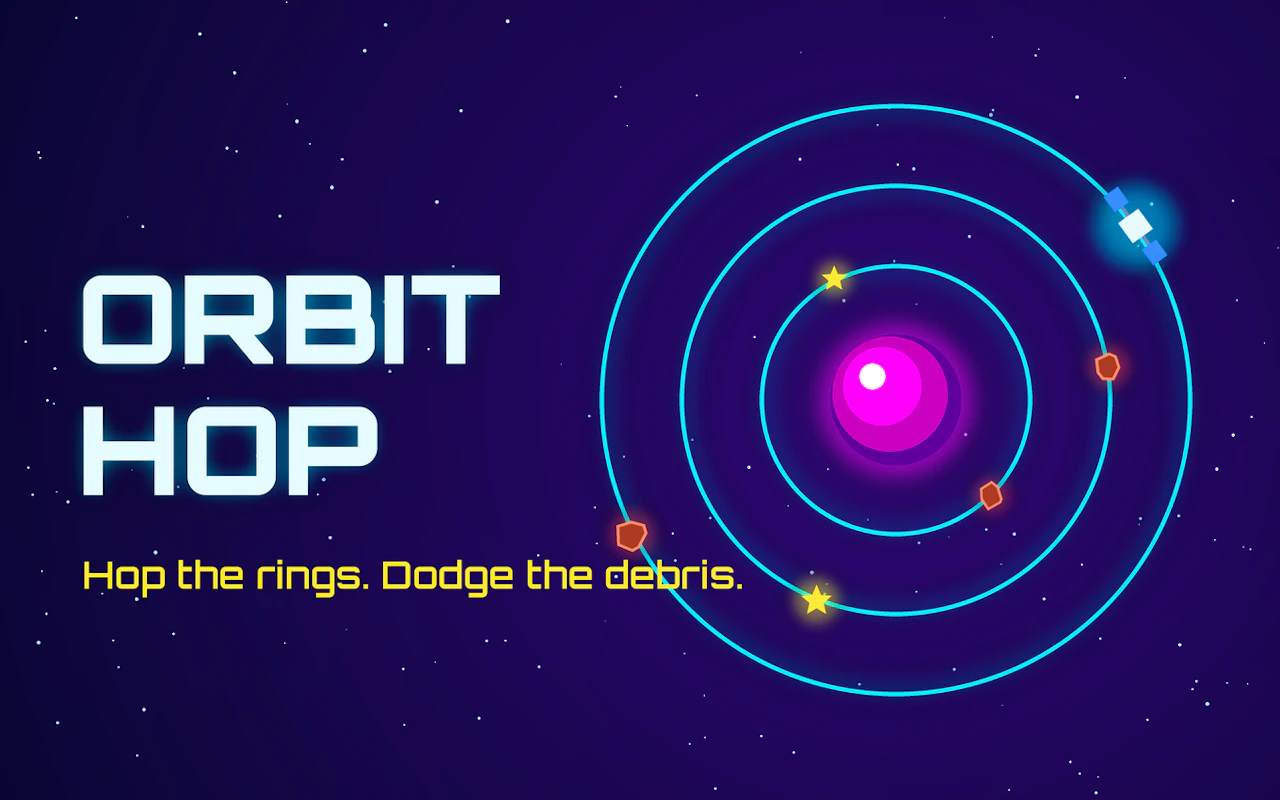
Orbit Hop is the genre in its purest form. You sit on a ring, wait, tap, and leap to the next. Mistime it and you drift away. Its own description calls it hyper-casual at its simplest, and that's accurate rather than modest.
Sword Balance swaps tapping for tiny corrections. Keep a sword upright for as long as your nerves allow. Small inputs, big consequences, and a phone held upright in one hand.
Jungle Vine Swing is one-tap swinging: let go at the right moment, grab the next vine, keep the run alive. Canyon Climb is a vertical version with simple taps and steady nerves, and Wall Bounce has you springing from wall to wall away from the hazards. All three are portrait, and all three take seconds to learn.
Glow Lanes is lane switching, left and right, avoiding whatever's coming. Dodge One Life does what its name says: one life, no do-overs mid-run, seconds to learn and rather longer to stop failing at. Both play on phones and computers alike.
The arcade ancestors
Hyper-casual didn't invent the one-button game. It just stripped it further. A few browser games sit right on that border, and they're often the more satisfying ones.
Geometrical Dash is a one-button platformer where a square jumps spikes and pits, level after level, with an attempt counter that records every failure. It has more structure than pure hyper-casual, since there are levels, but the control is a single tap. It's landscape, so it's better on a laptop.
Bouncing Egg uses taps only, hopping a fragile egg between spinning circles while the difficulty creeps up. Going Up keeps a pixel bird aloft with taps, and one late tap ends the flight. If you remember a certain bird game that took over every phone some years back, you know the feeling exactly.
Santabalt is an endless Christmas run where one tap or click is all the control you get, jumping Santa across rooftop gaps. Seasonal, silly, and exactly as deep as it needs to be.
The ad-heavy pattern, honestly
Here's the uncomfortable part. On app stores, hyper-casual became known less for its design than for its business model. Short runs mean lots of natural breaks, and lots of natural breaks mean lots of places to put an advert. A common setup is a video ad after every few failed runs, a banner along the bottom, and an offer to continue by watching one more. Some games add energy systems that limit how many runs you get before you wait or pay.
You can see a version of this on the store side of the site. Tomb of the Mask is a quick arcade climber, free and rated 4.7, with brief runs that suit one hand. Its free version has ads and an energy system, and a subscription removes both and adds daily coins. That's not a scandal. It's the model stated plainly, and it's to the listing's credit that it says so. Block Hexa Puzzle isn't hyper-casual at all, but it shows the same pattern in a calmer game: banner, interstitial and video ads in the free version, with a purchase to switch them off.
Browser versions vary, and the descriptions of the picks above don't cover their ad setups, so I won't pretend to know how each one handles it. The practical rule is the same everywhere: if the ads start to outnumber the runs, the game has told you what it's really for.
How to tell if one is worth it
A short test you can apply in the first five minutes:
- Does a failure feel like your fault? If deaths feel random, the mechanic is broken and no amount of polish fixes it.
- Does the restart take a second, or does it route you through a reward screen first?
- Is there a reason to get better? An attempt counter or a high score is enough. A progress bar that mostly fills from watching ads is not.
- Would you still play it with the sound off on a bus? Most good ones pass that easily.
Skip any hyper-casual game where the menu takes longer to read than a run takes to play. That's a design sending you a message.
If you like the one-button idea but want a little more underneath it, older arcade designs often do it better. The guide to old arcade ideas that still work in a browser is a decent next stop, since the one-button game was doing all this long before anyone thought to call it hyper-casual.