Free Puzzle Games to Play in a Browser Tab at Lunch
By IPObrains Editorial 5 min read
Free browser puzzle games sorted by the thinking they ask for, with matching, memory, logic and number picks, plus what to do when you get stuck.
In a crate-pushing game you can lose a level on your second move and not find out until your fortieth. That gap is the whole difference between a good puzzle and a bad one. The good one lets you trace a failure back to a single decision, even if you only spot it afterwards. A bad one just tells you that you lost and invites you to go again, a bit like a fruit machine that has learnt some long words.
Everything below runs free in a browser tab, with no download and no account. I've sorted the games by the sort of thinking they ask for rather than lumping them together, since a card-pairing game and a seating puzzle use completely different muscles. Pick the section that matches the bit of your brain you'd like to wake up.
Spatial games and things you can turn over
Most people's first puzzle game is a matching one. Plenty never move on, and honestly there's no shame in that, because the better examples ask more of you than their bright colours suggest.
Prism Match 3D puts its levels inside a 3D cube universe that you rotate and poke around. My advice for any puzzle where the object can be spun: look at every face before you make a single match. Commit only after the survey.
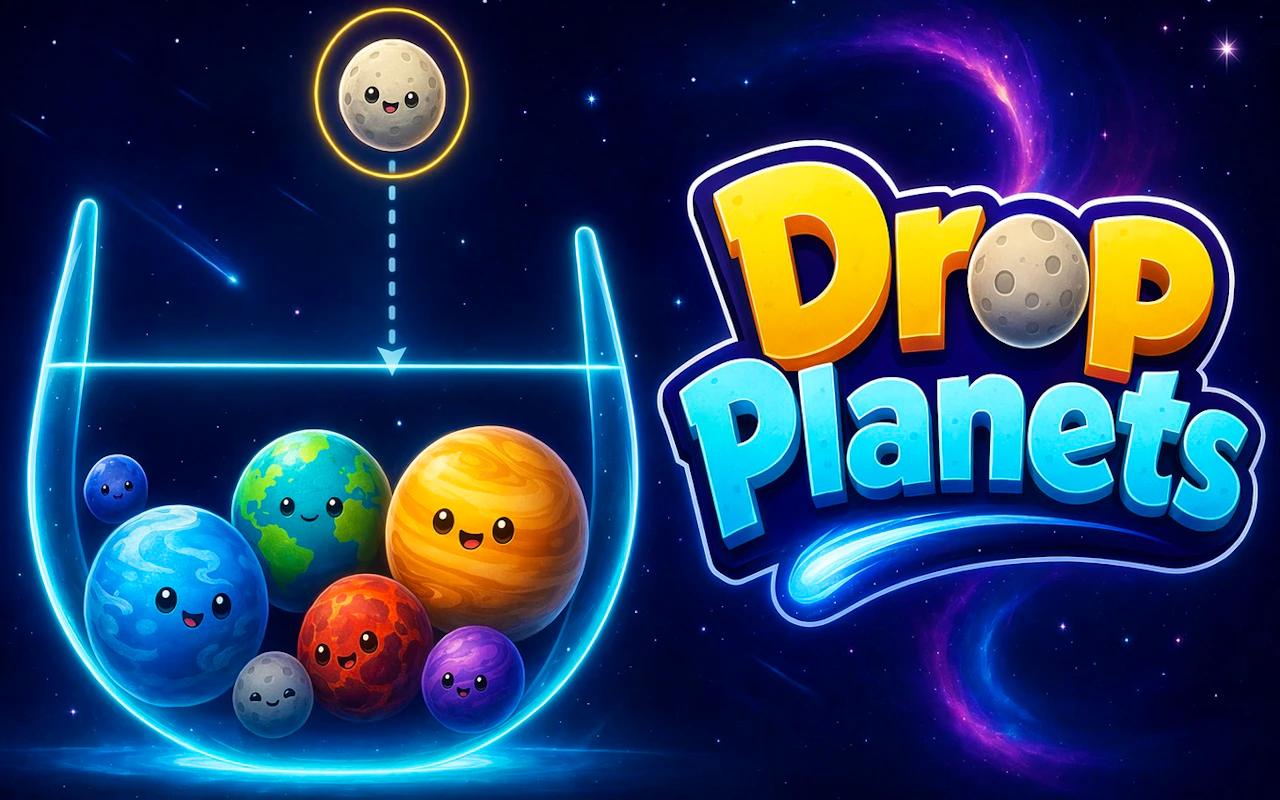
Drop Planets is free, and as the name suggests, you drop planets. The trap in drop games tends to be the middle column. It feels safe, so everything goes there, and suddenly it's full. Spread your drops on purpose, and keep one column empty as somewhere to dump a piece that fits nowhere else.
If matching feels too sleepy, Morphit and Cerkio lean on timing instead. In Morphit you change your shape to slip past obstacles. Cerkio gives you 30 levels of launching a ball at a target. Neither is deep, but both keep your hands busy.
Memory: the oldest trick still works
Pairs is ancient, which counts for it rather than against it. Memory Cards asks you to pick cards in the right order, and the levels get steadily nastier. It's plain, and plain is what you want when the goal is better recall rather than a light show.
Flag Memory Match sneaks in a second lesson. You can't remember where Portugal's flag sits unless you know what Portugal's flag looks like, so you end up learning geography by accident.
One trick I'd recommend: say each card's location as you flip it, aloud or silently. "Top left, red stripes." Putting a position into words may help you hang on to more of them. Twin Peeks is another twist on pairs, and Three Cups Game is the old shell game, where you follow one cup while the shuffling speeds up.
The Kobadoo games are short memory drills, each built on a single kind of thing. Kobadoo Shapes and Kobadoo Emojis drill symbols, while Kobadoo Flags sticks to flags. Try the naming trick on these and see whether your scores move.
Logic, where the real payoff is
This is the section that pays off away from the screen as well, so it deserves most of your time.
Seat the Guests is free, and judging by the name it's a seating problem, which is classic constraint territory. Guessing gets you nowhere with that sort of thing. What works is finding the guest with the fewest places they're allowed to sit, putting them down first, and then doing it again. Once you're used to it you'll notice the same method in sudoku, in loading a car for a holiday, and in sorting out who works which shift.
Sokoballs is about steering balls onto switches, and it punishes anyone who doesn't plan. Shove a ball against a wall and it may never come off again. So start from the end: where must each ball finish, and which directions can you still push it from? If you catch yourself nudging things just to see what happens, the level is already gone. The game simply hasn't mentioned it yet.
Robot Band - Find the differences tests your eyes rather than your reasoning, but it builds a good habit. Split the picture into an imaginary grid and check each square in turn. Your eye will want to leap to whatever is brightest. Don't let it.
Sums wearing a disguise
Nobody owns up to practising mental arithmetic, but it's a puzzle skill like any other. Kobadoo Arithmetic and Kobadoo Numbers mix memory with quick sums and make a decent warm-up. Math Fight Club turns the sums into a contest, which is handy if your adding up collapses the moment someone's watching.
Then there's Merge Royal, where you combine matching cards to reach bigger numbers. The merging itself is trivial. The real question is whether to merge now or hold off for a larger combination, and that's maths pretending to be housework.
Getting stuck properly
You can get noticeably better at puzzles fairly fast, and most of it comes down to what you do when you're stuck rather than how many hours you put in.
Look at the whole board before you move. The first move feels free, so people waste it. It isn't free.
When you hit a wall, undo two moves, not one. The mistake almost always happened before the point where it became obvious.
Take the hint if there is one, and take it sooner rather than later. A winning streak means nothing if you never understood the pattern, whereas a pattern you've understood keeps paying out for the rest of the game.
And when you get cross, switch games. Some skills carry over from one title to the next. Bad temper carries over too, but only into your next ten moves, all of which will be worse.
For puzzles with no single right answer, where you weigh up trade-offs instead, try our strategy games for brain training. On an ageing phone or laptop, check best games for low-end devices before you start.
Here's tonight's task. Pick one game from the logic section, give yourself ten minutes, and turn your phone over. Note the first move you wish you could take back. That's tomorrow's homework.